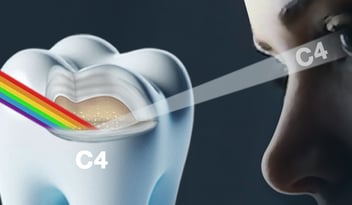



If shade selection has ever felt more complicated than it needs to be, you’re not alone. In this recent webinar, industry expert Gregor Connell took a practical, engaging look at how simplified shading systems are changing the way clinicians think about esthetics, efficiency, and everyday restorative dentistry.
In case you missed it, here’s a quick overview of the discussion, plus three standout takeaways that make this session well worth a watch.
A New Way to Think About Shade Selection
The webinar explored the industry’s steady shift away from large, complex shade inventories toward more streamlined approaches that still deliver predictable, natural-looking results. As Gregor explained early on, the goal isn’t to sacrifice esthetics, but ratjer to reduce unnecessary complexity while working with how light interacts with tooth structure.
As he put it, “Clinically, shade matching has always been a bit of a challenge.” The session focused on how material science and optical behavior are helping address that challenge in smarter, more efficient ways.
Three Key Highlights from the Webinar
1. The Evolution Toward Simplicity
Rather than chasing dozens of individual shades, Gregor framed modern shade selection as an evolution—one grounded in understanding brightness, intensity, and how natural dentition actually appears, “What I’m going to do tonight is basically take you on a little journey… what I call shade evolution.” That journey highlights why fewer, thoughtfully designed shade groupings can often deliver more predictable results than traditional approaches.
2. Why Particle Technology Matters
One of the most eye-opening sections of the webinar focused on how advanced filler technology influences light transmission, and ultimately shade blending.
“All nano particulate in dentistry is spherical. Full stop right there.”
Because light passes through these particles with minimal distortion, restorations can better reflect the surrounding tooth structure, helping achieve a more natural appearance with fewer shade choices.
3. Bridging Esthetics and Efficiency
A major theme of the presentation was the balance between translucency (needed for depth of cure and blending) and opacity (essential for esthetics).
As Gregor explained, “This transformation technology… actually bridges the gap between what is an opaque esthetic composite and a highly translucent single or bulk-fill shaped composite.”
That balance is key to simplifying workflows without compromising clinical outcomes.
Want the Full Picture?
This webinar delivers far more than theory. It offers real-world insights into how simplified shading systems can support predictable esthetics, streamlined inventory, and confident shade selection in daily practice.
If you’d like to dive deeper into the science, clinical examples, and practical takeaways, be sure to watch the full on-demand recording at VOCOLearning.com.
As Gregor summed it up best: “The only thing constant that I’ve been seeing in the last [several] years is change.” This session is a great opportunity to stay ahead of it.