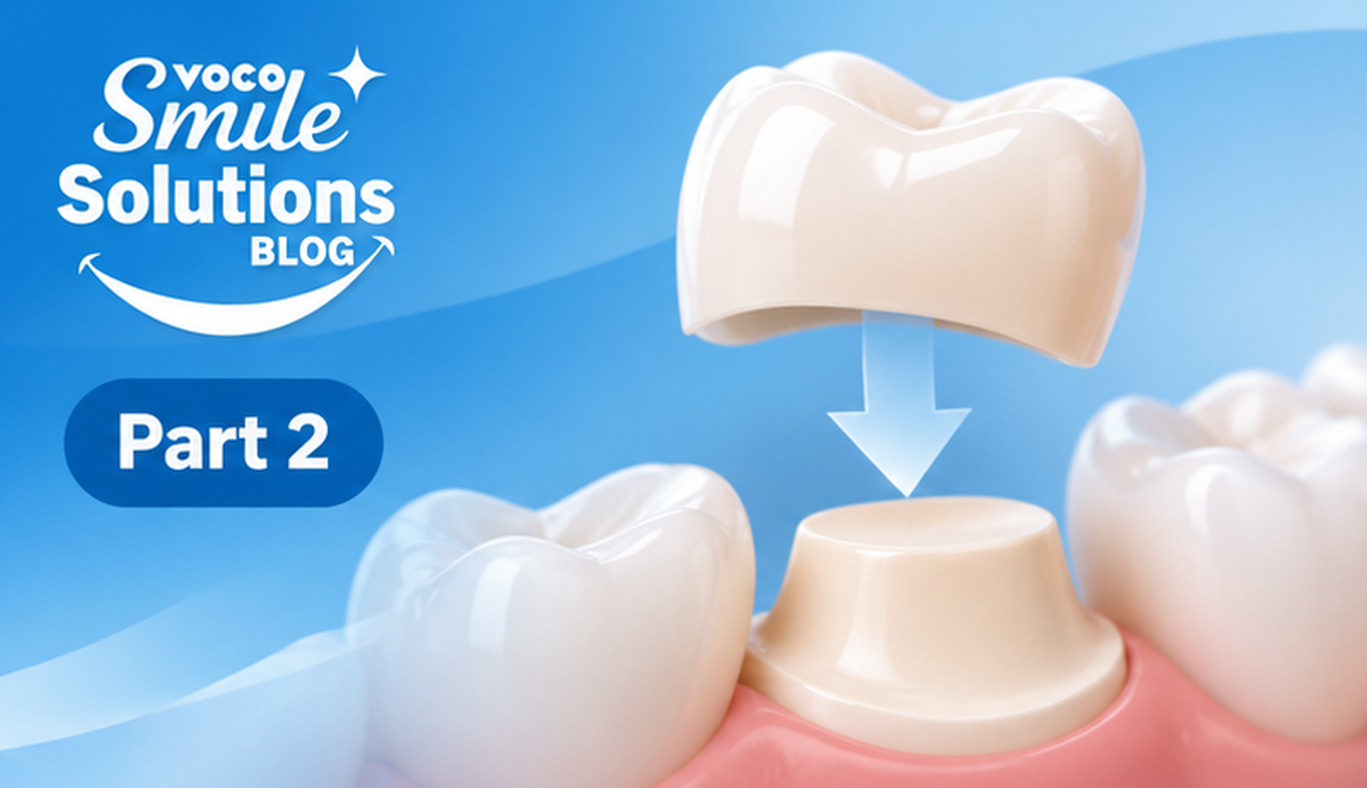
Part I - Simplifying Cementation: Rethinking the Capabilities and Limitations of Modern Cementation
If there’s one area in dentistry that consistently creates confusion, it’s knowing which type of cement to use and when. Clinicians often struggle with the number of options, and with so many materials available, each with overlapping indications, it becomes easy to second-guess decisions, especially when outcomes aren’t always consistent.
But when you strip it down, the decision is much simpler than it appears.
In most cases, predictable cementation comes down to understanding three categories of materials and how they relate to the clinical situation in front of you:
- Resin-modified glass ionomer (RMGI)
- Self-adhesive resin
- Adhesive resin
The challenge isn’t memorizing their properties. It’s knowing how to think about them.
Start with the Prep, Not the Cement
One of the most common mistakes in cement selection is starting with the material instead of the preparation.
The better place to start is with a simple question:
Is the preparation retentive, or not?
That distinction alone does more to guide cement selection than anything else.
When a preparation has adequate height, proper taper, and good resistance form, it provides a level of mechanical stability that reduces the demand on the cement. In those cases, the cement doesn’t need to do all the work—it just needs to support what’s already there.
When a preparation lacks those features, the situation changes entirely. Now the cement isn’t just supporting the restoration, it’s responsible for holding it in place.
That’s where material selection becomes critical.
Where RMGI Fits
RMGI cements tend to perform best in situations where the preparation is already doing most of the work.
They are reliable, forgiving, and generally associated with low post-operative sensitivity. For many clinicians, they’ve become the go-to option for routine cases, especially when working with zirconia or metal-based restorations.
In a well-retentive prep, an RMGI cement often provides everything that’s needed: adequate adhesion, ease of use, and predictable outcomes without unnecessary complexity.
Where they fall short is in situations that demand higher bond strength. If the prep is compromised, relying on an RMGI alone can lead to failure. This isn’t because the material is inadequate, but because it’s being asked to do more than it was designed to do.
The Role of Self-Adhesive Resin
Self-adhesive resin cements sit somewhere in the middle.
They were designed to simplify the bonding process by eliminating the need for a separate adhesive step, while still offering improved bond strength compared to traditional cements.
In practice, they’re often used as a versatile, “one-step” solution. For many cases, especially when the prep is reasonably retentive, they offer a balance between simplicity and performance.
They also tend to be more esthetic than RMGIs, which makes them a strong option for glass ceramic restorations in the anterior where translucency matters.
That said, they’re not a replacement for true adhesive systems in more demanding situations. While their bond strength is good, it doesn’t match what can be achieved with a full adhesive protocol.
So while they can handle a wide range of indications, there’s still a threshold where they’re no longer the best choice.
When Adhesive Resin Becomes Necessary
Adhesive resin cements are where bond strength becomes the priority.
These systems are more technique-sensitive and involve additional steps, but they offer the highest level of adhesion available in cementation. When a preparation lacks retention, or when working with materials that depend on bonding (such as glass ceramics or hybrid materials) this is where adhesive resin cements become essential.
They’re not always the fastest option, and they do require more attention to detail. But in cases where retention is compromised, they provide a level of security that simpler systems cannot.
In many ways, they act as the safety net for difficult cases.
Matching the Material to the Situation
Beyond preparation design, the type of restorative material also plays a role in cement selection.
Zirconia, for example, can often be successfully cemented with RMGI when the prep is retentive. If retention is questionable, moving to an adhesive resin system provides additional security.
Glass ceramics tend to lean more toward resin-based cements, particularly when esthetics and bond strength are important. In these cases, self-adhesive or adhesive resin cements are typically preferred over RMGI.
Hybrid materials, especially CAD/CAM composites, are even more dependent on adhesion, making adhesive resin cements the more predictable choice.
These distinctions don’t need to be overly complicated. In most cases, they reinforce the same underlying principle:
The less help you get from the prep, the more you need from the cement.
Where Things Go Wrong
Problems in cementation often come from using the right material in the wrong situation.
An RMGI placed on a non-retentive prep may fail, not because the cement is poor, but because it wasn’t designed for that level of demand.
A self-adhesive resin used in a case that requires maximum bond strength may perform adequately at first, but lack long-term predictability.
On the other end of the spectrum, using a full adhesive system in a simple, retentive case may add unnecessary complexity without providing a meaningful benefit.
In each of these scenarios, the issue isn’t the product, it’s the mismatch between the material and the clinical need.
Simplifying the Decision
When viewed through the right lens, cement selection becomes much more straightforward.
Instead of navigating a long list of products, the decision can be guided by two primary factors: how retentive the preparation is, and how much adhesion the situation requires.
From there, the categories fall into place.
RMGI for strength through simplicity.
Self-adhesive resin for versatility and efficiency.
Adhesive resin for maximum bond strength when it matters most.
Once that framework becomes familiar, the process starts to feel less like guesswork and more like a consistent, repeatable approach.
What Comes Next
Even with the right cement selected, outcomes can still vary.
Sensitivity, debonding, and marginal issues don’t always come down to the material itself. More often, they’re tied to technique. These small steps that are easy to overlook but have a significant impact on performance.
In the next article, we’ll take a closer look at where cementation commonly breaks down and how to correct those issues to improve consistency across every case.